
EU science ministers agree on research assessment reform
Ministers sign off joint positions on international cooperation, research assessment, open science and Horizon Europe missions in Luxembourg meeting
Member-only content is available on this page. Please log in to view this content.
571 item(s) found
Ministers sign off joint positions on international cooperation, research assessment, open science and Horizon Europe missions in Luxembourg meeting
Science Europe welcomes the Council Conclusions on research assessment and open science as they recognise the need for a renewed approach to research policies and practices to evolve towards a more positive research culture.
We are pleased to welcome the National Research Foundation of Ukraine (NRFU) and the Hungarian Academy of Sciences (MTA) as members of Science Europe.
After months of negotiations, research stakeholders in the EU are getting close to an agreement on a set of principles and commitments for reforming the way research outputs are evaluated.
On the occasion of the Science Day organised by the National Research Foundation of Ukraine (NRFU), Science Europe and its Member Organisations again express their solidarity with the people of Ukraine.
As of 18 May, Science Europe counts 40 Member Organisations from 30 European countries. On that date, the General Assembly unanimously approved the applications of the Hungarian Academy of Sciences (MTA) and the Ukrainian National Research Foundation (NRFU).
Science Europe welcomes the DFG position paper "Academic Publishing as a Foundation and Area of Leverage for Research Assessment" on two important and timely topics.
Curiosity is the driving force of discoveries and research. To inspire youth to discover the wonderful world of science and research, ETAG held a national Student Researcher's Festival on 12 and 13 April.
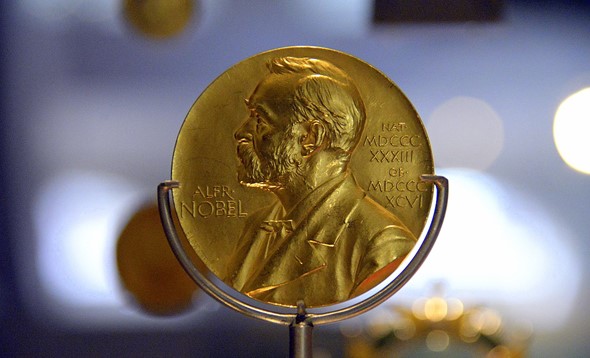
The 2021 Galileo Galilei Medal was awarded to Alessandra Buonanno, Thibault Damour, and Frans Pretorius.
The Italian National Institute of Nuclear Physics celebrated its 70th anniversary, growing from a research institute on the atomic nucleus and cosmic particles to a reference point in Italy and internationally on research in particle physics.
On 29 April, the Marie Curie Alumni Association (MCAA), Formas, and Science Europe organised an online panel discussion on ‘Good Advice for (Young) Science-Policy Advisors’, as a side event to the conference ‘Science Advice Under Pressure’ by SAPEA (Science Advice for Policy by European Academies).
The reform of research assessment initiative continues to take major steps forward, with several milestones on the horizon this month.
Together with cOAlition S, OPERAS, and ANR, Science Europe organised the first webinar for the organisations and individuals who endorsed the 'Action Plan for Diamond Open Access'. Since its launch, it has been endorsed by over 80 organisations and more than 50 individuals.
How to become an effective science-policy advisor? Top experts and early career researchers discuss careers, skills, training, organisations, and lessons learnt between policy engagement and scientific integrity.
The report of the symposium ‘Science for Net-Zero Transition: Linking Green Objectives with Societal Development’ was published.
Substantial discrepancies exist in European research and innovation capacity. To support capacity-building in European countries with lower R&I performance, Science Europe and its Task Force on Widening Participation and Spreading Excellence are launching a series of activities.
Thierry Damerval is the President and CEO of the French National Research Agency (ANR), as well as a Member of the Science Europe Governing Board. Secretary Lidia Borrell-Damián spoke with him on 15 March in relation to the French Presidency of the Council of the EU in the first half of the year.
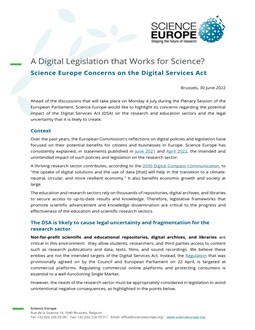
Research organisations, libraries, repositories, and university networks call for the the exclusion of not-for-profit repositories, digital archives, and libraries from the obligations of the Digital Services Act.
Science Europe, cOAlition S, OPERAS, and ANR organise a webinar on 22 April for the endorsers of the Action Plan for Diamond Open Access to gather their views on the next steps.
Report of the 8 November 2021 Symposium 'Science for Net-Zero Transition', co-organised by CESAER, the International Sustainable Campus Network, Science Europe, and the University of Strathclyde, as a side-event to COP26.
Science Europe's newest member organisation, the Science Fund of the Republic of Serbia, celebrates its third anniversary.
On 1 March, the European Commission appointed three eminent scientists as new members of the Scientific Council of the European Research Council (ERC): Professor Chryssa Kouveliotou, Professor László Lovász, and Professor Giovanni Sartor. They are appointed for an initial period of four years.
The European Commission initiative to reform research assessment continues to develop at pace. A first public political announcement about the initiative was made as part of the Paris Open Science European Conference 2022 (OSEC2022) on 4 and 5 February.
Science Europe’s newest Member Organisation, the Science Fund of the Republic of Serbia (SFRS), was established in March 2019 and celebrates its third anniversary in the coming month.
Science|Business, a Brussels-based organisation bringing together industry, research and policy, recently released a paper called ‘Horizon Europe: the first assessment’. This paper builds on feedback gathered from an online survey and meetings with Science|Business’ member organisations.