
Science Europe’s celebrations in full swing
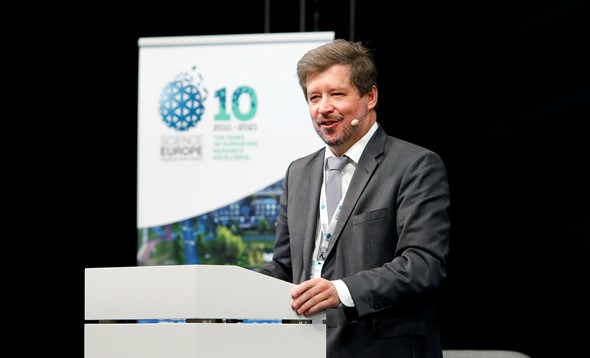
On the occasion of the 2021 High Level Workshop, Science Europe celebrated its 10th anniversary and its achievements during that period.
Member-only content is available on this page. Please log in to view this content.
183 item(s) found
On the occasion of the 2021 High Level Workshop, Science Europe celebrated its 10th anniversary and its achievements during that period.
Science Europe welcomes the adoption by the Council of the European Union of the Conclusion on the future governance of the European Research Area and Recommendations on a Pact for Research and Innovation.
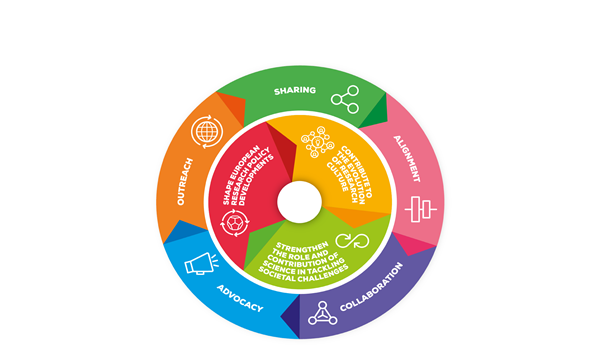
On 25 November 2021, Science Europe releases a vision for Research Culture in the European Research Area (ERA) and commits to collective actions that enable a thriving research system.
The partners of the Science for Net-Zero Symposium CESAER, the International Sustainable Campus Network (ISCN), Science Europe, and the University of Strathclyde are calling for a collaborative, systems-based approach to tackling the Net-Zero emissions challenge, and are taking immediate steps to lead by example.
On 26-27 October 2021, the Slovenian Presidency of the Council of the European Union organised the “Conference New ERA - Towards a responsible knowledge driven society of the 3rd Millennium.” It was intended to better integrate the ERA in key stakeholder communities, industrial sectors and policymakers on regional, national and EU levels, especially those responsible for research and from broader innovation ecosystems.
The Nobel Prizes were announced between 4 and 11 October this year, honouring the greatest achievements in medicine, physics, chemistry, literature, peace, and economic sciences.
Science Europe was launched formally in its first General Assembly on 21 October 2011 in Berlin. A total of 49 Member Organisations, including the seven official founding members (DFG, ESRC, ETAg, FWO, FNRS, ARRS, and SNSF), celebrated the start of the association and elected its first President, Paul Boyle, and Governing Board.
On 24 November, Science Europe, in collaboration with the Luxembourg National Research Fund (FNR) and the Luxembourg Ministry of Higher Education and Research (MESR), will organise the 13th high Level Workshop – this year on the topic of ‘Research Culture’.
Want to join us and help us strengthen innovative European research? Science Europe currently has an open vacancy for the post of Policy Officer.
With great sorrow, Science Europe learned of the passing of Professor Jaroslav Koča, President of the Czech Science Foundation, on 2 July 2021. Science Europe extends its deepest condolences to Professor Koča's family, friends, and colleagues at the Czech Science Foundation.
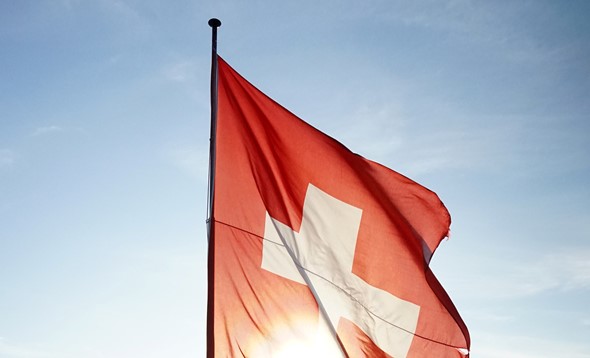
Non-EU European countries, such as Norway, Iceland, the United Kingdom, and Switzerland contribute to the excellence of the European Research Area (ERA). Guaranteeing the full association of Switzerland to Horizon Europe is a pressing and critical issue for European Research and Innovation (R&I).
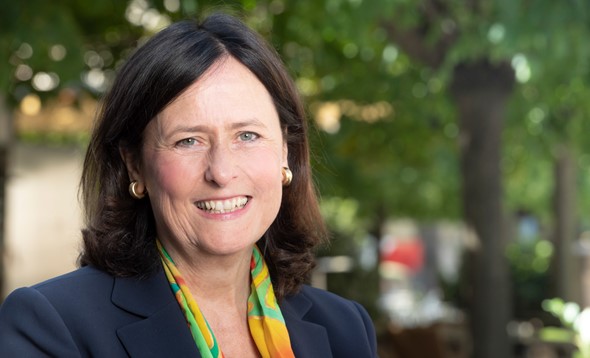
Science Europe congratulates Prof. Maria Leptin on her appointment as the next European Research Council (ERC) President.
The Global Research Council (GRC) 2021 Annual Meeting, hosted by UK Research and Innovation (UKRI) and the National Research Foundation (NRF) in South Africa, took place remotely between 24 and 28 May 2021. It was preceded by the regional events and meetings of the various GRC groups.
We are pleased to announce that Science Europe is now issuing Digital Object Identifiers (DOIs) for its publications and depositing its publications on the Zenodo platform.
How research policies must adapt: association launches new Strategy Plan 2021-2026 and Multi-annual Action Plan 2021-2026.
Science Europe signs the Open Letter of the European STI Councils and Advisory Bodies on the participation of Switzerland under Horizon Europe
The Science Europe General Assembly adopted the creation of a new working group on Open Science (WG OS) to develop a comprehensive approach towards the topic. WG OS will provide a platform to bring together the Open Science aspects embedded in all activities of Science Europe. It will also broaden the scope of our work in the area, to fulfill the objectives described in the new Science Europe Strategy and Multi-annual Action Plan.
On 20 May, the European participants of the Global Research Council (GRC) re-elected Professor Katja Becker, President of the German Research Foundation, to represent them in the GRC Governing Board.
On 19 May the Science Europe General Assembly accepted two new research organisations to the association: research performing organisation the Eötvös Loránd Research Network (ELKH) from Hungary and the dual research funding and performing organisation the Institute of Health Carlos III (ISCIII) from Spain.
CESAER, the European University Association (EUA), and Science Europe call on all publishers to fully respect researchers’ rights and to end the use of restrictions and embargoes.
The Science Europe Practical Guide to the International Alignment of Research Data Management (RDM Guide) has seen an important uptake, being referenced and used by a large number of stakeholders within and beyond European borders.
The Foundation for Science and Technology (FCT) is a crucial actor in the Portuguese research and Innovation landscape, therefore playing an important role in the implementation of the Portuguese priorities during the Presidency period. Lidia Borrell-Damian, Secretary General of Science Europe, interviewed Professor Helena Pereira, President of FCT to discuss the presidency, ERA, and the work of FCT.
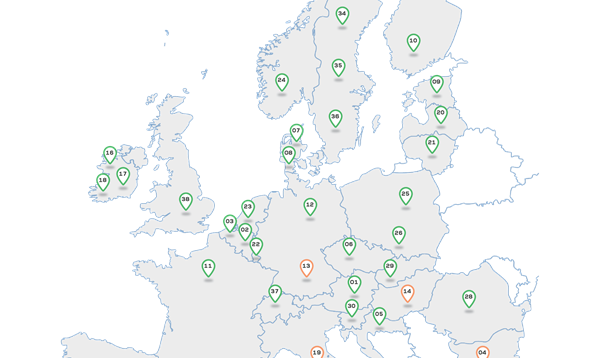
Science Europe's Statement on the Participation of Associated Countries in Horizon Europe’s Pillar II
Science Europe and cOAlition S are pleased to announce the publication of an in-depth report and recommendations arising from a study of community-driven Open Access journals across the world that are free for readers and authors, usually referred to as 'OA diamond journals'.