
Science Europe Joins other R&I Organisations to Call for Full Swiss Association to Horizon Europe.
Science Europe signs the Open Letter of the European STI Councils and Advisory Bodies on the participation of Switzerland under Horizon Europe
Member-only content is available on this page. Please log in to view this content.
120 item(s) found
Science Europe signs the Open Letter of the European STI Councils and Advisory Bodies on the participation of Switzerland under Horizon Europe
The year 2020 saw a global pandemic attest to the value of science. In the race for COVID-19 treatments and vaccines, Science Europe’s Member Organisations were at the forefront of the global response and our association became more relevant and important than ever.
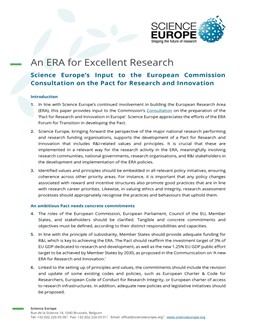
The European Commission approach to the ‘ERA Pact for Research and Innovation in Europe’ should be as inclusive as possible. Its development and implementation need to include research communities, national governments, research organisations, and R&I stakeholders.
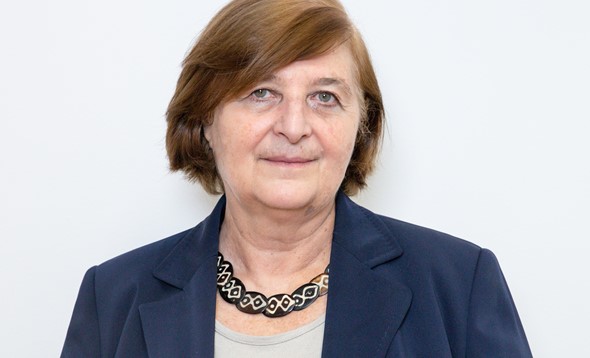
The Foundation for Science and Technology (FCT) is a crucial actor in the Portuguese research and Innovation landscape, therefore playing an important role in the implementation of the Portuguese priorities during the Presidency period. Lidia Borrell-Damian, Secretary General of Science Europe, interviewed Professor Helena Pereira, President of FCT to discuss the presidency, ERA, and the work of FCT.
Science Europe's Statement on the Participation of Associated Countries in Horizon Europe’s Pillar II
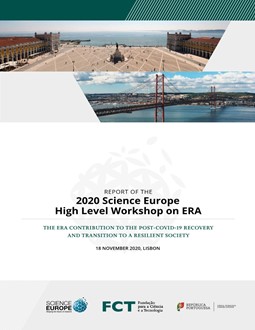
The 2020 edition of the Science Europe High Level Workshop on ERA was co-hosted with the Foundation for Science and Technology and the Portuguese Ministry of Science, Technology, and Higher Education. It explored how research and innovation can contribute to crisis recovery and to societal resilience in the context of an evolving research culture.
The 2020 edition of the annual High Level Workshop on ERA explored how research and innovation can contribute to the recovery from the COVID-19 crisis and to societal resilience, in the context of an evolving research culture.
Together with LERU, EUA, EARTO, and the Vice-Presidents of the European Research Council (ERC), we join MEP Christian Ehler from the EEP Group in his call to match the Green & Digital goals with a budget fit for this age.
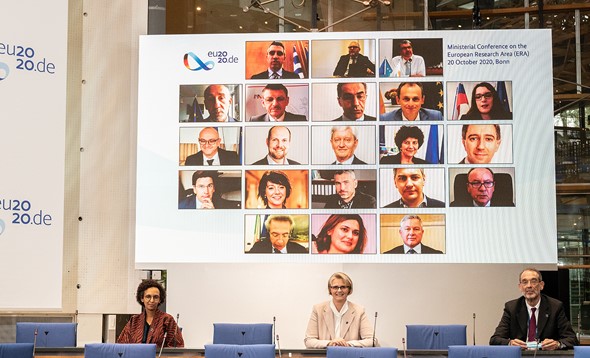
Science Europe welcomes the adoption of the Bonn Declaration on ‘Freedom of Scientific Research’ at today’s Ministerial Conference on the European Research Area in Bonn. Academic freedom is of utmost importance for democratic societies to continue building Europe’s resilience.
Science Europe welcomes the European Commission’s ambitious Communication for ‘A New ERA for Research and Innovation.’ To further strengthen Europe’s world-leading research, a strong ERA is essential and must be based on research excellence, international collaboration, openness, inclusiveness, and academic freedom.
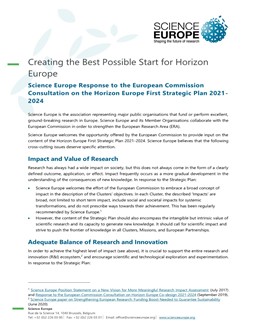
In its response to the European Commission, Science Europe outlines numerous topics that should be further addressed in order to create the best possible start for Horizon Europe. Such developments include striking the right balance between research and innovation, embedding the whole spectrum of equality aspects, better integration of Social Sciences and Humanities, and the creation of synergies between the various parts of the programme.
Science Europe welcomes the European Commission’s ambitions for digital and green transformation as highlighted by President von der Leyen today.
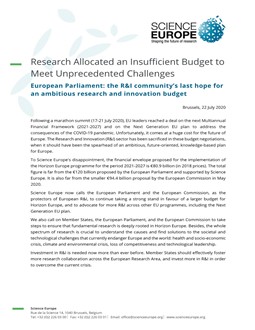
The Research and Innovation (R&I) sector has been sacrificed in these budget negotiations, when it should have been the spearhead of an ambitious, future-oriented, knowledge-based plan for Europe. Science Europe now calls the European Parliament and the European Commission, as the protectors of European R&I, to continue taking a strong stand in favour of a larger budget for Horizon Europe
Science Europe calls on the leaders of the EU to dedicate increased funding to research and innovation at the 19 June European Council meeting on the EU long-term budget and COVID-19 recovery fund.
An increased budget is necessary to meet the ambitious objectives of the European Union for a sustainable, healthy planet, and to ensure the global competitiveness of its research sector.
Science Europe also emphasises the need for sustained European leadership in tackling all COVID-19-incurred challenges.
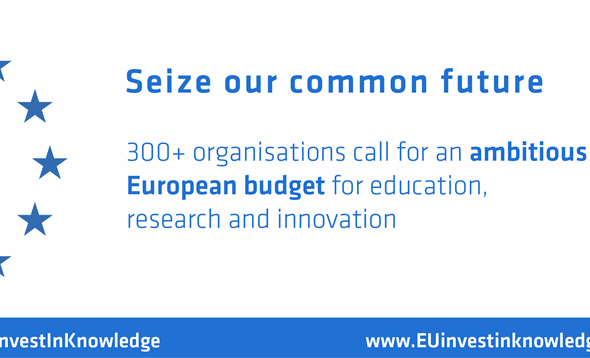
Science Europe joins 300+ organisations in call to EU decision-makers to pledge ambitious EU Budget on vital R&I.
Science Europe warmly welcomes the strong commitment from Mariya Gabriel, Commissioner-designate for Innovation and Youth, to support excellent research in Europe. Research is essential for Europe to address the societal challenges, and lead the transition to a sustainable and digital economy and society.
Ahead of the trilogue negotiations on the EU Budget for 2020, Science Europe calls on the Council to agree to a substantial budgetary increase for Horizon 2020. Outcomes of Horizon 2020 provide a key contribution to long-term economic growth, European competitiveness, and in finding solutions to societal and global challenges.
For Horizon Europe’s ‘Strategic Plan’ 2021-2024, Science Europe urges the European Commission to support cutting-edge research and innovation at all Technological and Societal Readiness Levels, and to adopt objectives that are not limited to short term impact. Europe should dare to explore unexplored paths and support riskier experimentation. Moreover, Science Europe recommends to reinforce a series of cross-cutting factors to increase the scientific, economic, and societal impacts of Horizon Europe.
Science Europe, the Academy of Finland, and the Finnish Ministry of Education and Culture are organising the 11th annual High Level Workshop on the European Research Area (ERA) in Helsinki on 10 and 11 September 2019.
Science Europe congratulates Professor Mauro Ferrari on his appointment as the next President of the European Research Council (ERC) and wishes him all the best in this future role.
Science Europe welcomes the Political Partial Agreement on Horizon Europe, voted on today in plenary by the European Parliament. Science Europe is very pleased to see that excellence remains the core principle of the programme. However Horizon Europe’s ambitions can only be met with the appropriate funding and we therefore advise that Horizon Europe is granted a budget of at least €120bn.
The success of the European Research Council (ERC) relies on its autonomy and on the impeccable management of its administrative wing, the Executive Agency (ERCEA). Pablo Amor, Director of the ERCEA, has stood as a staunch guarantor for both over the past eight years.
In view of the upcoming trilogues between the three European institutions, Science Europe invites all parties to consider a series of elements to further improve the legislative package for Horizon Europe. The budget of €120bn proposed by the European Parliament is a very welcome proposal and should be taken up by the Council in the next Multiannual Financial Framework. Moreover, fundamental research must be included in all parts of the programme, including the European Innovation Council.
The overall funding for research and innovation in Europe needs to be increased and an adequate ring-fenced budget should be provided for Horizon Europe. In this factsheet Science Europe illustrates some of the reasons why.
The European Commission proposal for Horizon Europe falls short of acknowledging the importance of fundamental research. This factsheet demonstrates the essential role fundamental research plays, not only for research, but also for innovation.