
-
Share on




When Science Responds to Crisis: Protocol for Scientific Advisory in Disasters and Emergencies by CSIC
When Science Responds to Crisis: Protocol for Scientific Advisory in Disasters and Emergencies by CSIC
When disaster strikes, scientific expertise can make a critical difference. But scientific excellence alone is not enough. The right knowledge must be identified, connected, coordinated and made available to decision-makers at the speed required by an emergency.
This is the challenge that the Spanish National Research Council (CSIC) set out to address through its Protocol for Scientific Advisory in Disasters and Emergencies (PADE) and the Scientific Advisory Groups for Disasters and Emergencies (GADE).
A key step was driven by the CSIC Presidency, which strongly supported the transformation of the extensive emergency-response experience accumulated across different CSIC institutes into a unified institutional framework. The objective was not to create new expertise, but to connect, coordinate and mobilise the scientific and technical capabilities already distributed across CSIC whenever society needs them. The protocol has been operational since 2024 and has already been activated on 12 occasions.
As Eugenio Fraile, Deputy Director for Scientific Affairs at the Spanish Institute of Oceanography (IEO-CSIC) and Coordinator for Marine Risks within GADE-CSIC, explains: “PADE is the protocol; GADE is the scientific capability that the protocol mobilises.”
CSIC is Spain’s largest public research organisation, with 121 research institutes, three National Centres, highly specialised laboratories, major scientific infrastructures and a community of around 18,000 researchers, technicians and support staff. This breadth represents an extraordinary scientific resource, but also poses an organisational challenge: how can such a distributed institution react coherently and rapidly when an emergency occurs?
Organising complexity before the emergency
The activation pathway may appear complex on paper, but one of the strengths of PADE is precisely that this complexity has been organised in advance. In practice, the scientific response can become operational within a few hours.
An official request for scientific support reaches CSIC’s emergency coordination structure. It is transferred to the Presidency of CSIC and communicated to the Ministry of Science. Once the decision to intervene has been taken, the appropriate GADE is activated together with the specific capabilities needed for that particular emergency.
The key principle is simple: when an emergency occurs, CSIC does not have to invent the organisation or start searching for experts from scratch. It activates a structure that already exists.
The response is modular and organised around six complementary functions. A Scientific Desk brings together researchers working remotely with models, satellite observations, forecasts, GIS and other scientific data. An Operational Group deploys researchers and technical staff directly to the affected area, working alongside the personnel managing the emergency. Reference laboratories provide specialised analyses, while Occupational Risk Prevention teams ensure the safety of deployed personnel and provide the necessary protective equipment.
At the same time, Communication specialists participate in the emergency information flow, translate scientific evidence into reliable public information and identify appropriate CSIC experts to act as spokespersons. Finally, a Management function provides the administrative, logistical and organisational support required to keep the response operating.
This means that activating GADE does not simply mean activating a group of scientists. It means mobilising an integrated scientific-response system combining analysis, field operations, laboratories, safety, communication and management.
Importantly, this scientific support is provided at no direct cost to the administration requesting the activation, removing a potential barrier to accessing scientific expertise during a crisis.
From scientific advice to operational capacity
GADE therefore goes well beyond the traditional concept of an advisory committee.
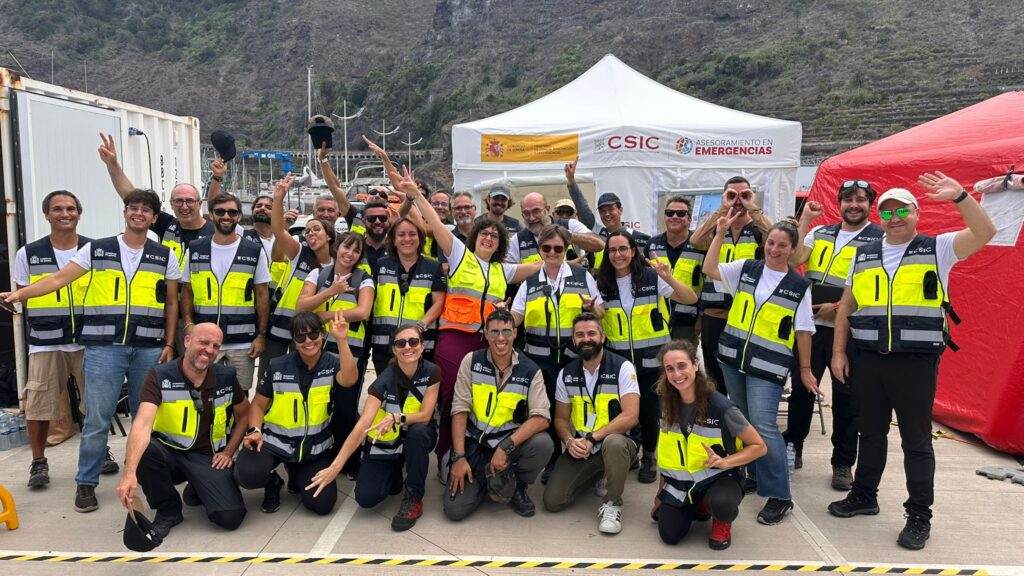
Depending on the emergency, scientists can participate in technical and scientific committees, analyse observations, develop scenarios, assess uncertainty, prepare scientific-technical reports and provide recommendations to emergency managers. But CSIC can also deploy researchers and technicians into the field, collect samples, operate specialised instrumentation and work directly with operational response teams.
Behind them lies the infrastructure of a major research organisation: oceanographic vessels, underwater robots, drones, specialised laboratories, satellite observations, modelling systems, GIS platforms and other advanced scientific capabilities.
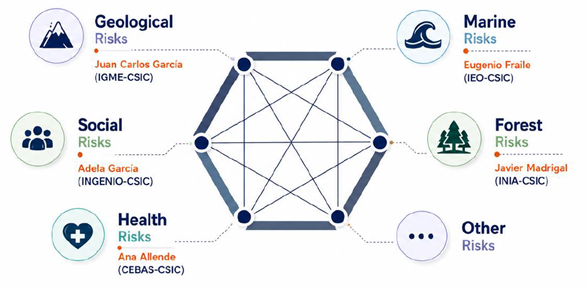
The model is necessarily multidisciplinary because emergencies rarely fit neatly within one scientific discipline. A volcanic crisis, for example, may require volcanology, geochemistry, oceanography, air-quality expertise, infrastructure specialists, drones and social sciences. A major flood can rapidly become a problem involving hydrology, contamination, public health, infrastructure, marine impacts and social recovery.
As Fraile puts it, “Complex emergencies do not respect disciplinary boundaries. The scientific response cannot be organised in silos.”
From accumulated experience to an institutional system
The creation of PADE-GADE did not start from zero. Its foundations lie in decades of emergency-response experience across different CSIC institutes.
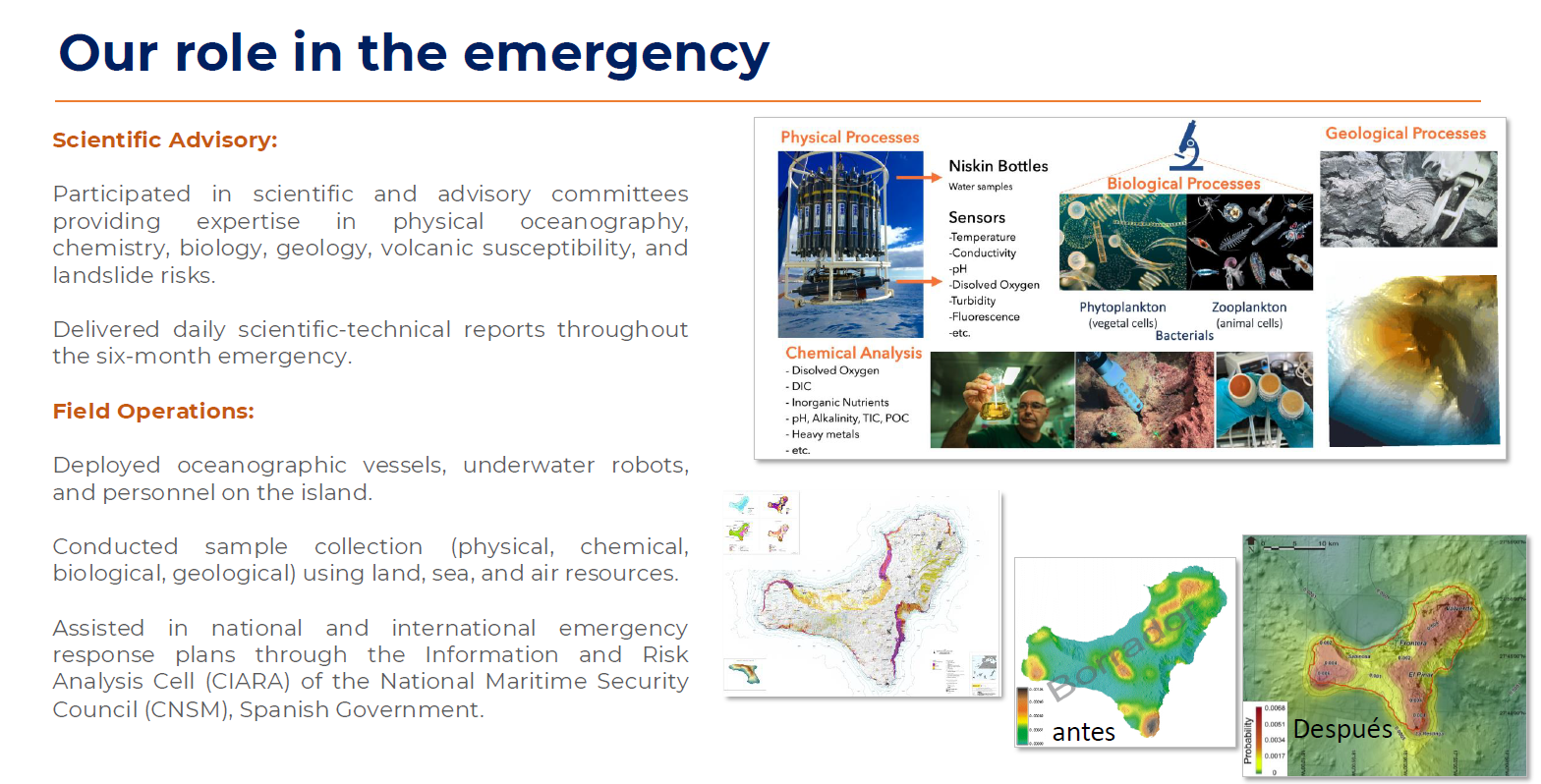
During the 2011 submarine volcanic eruption of El Hierro, multidisciplinary scientific teams provided daily advice throughout a six-month emergency, while oceanographic vessels, underwater robots and scientific personnel were deployed to the affected area.
In 2015, following the sinking of the Oleg Naydenov off Gran Canaria, scientists produced more than one hundred reports and pollutant-dispersion forecasts over several months, helping translate oceanographic modelling into operational decisions for environmental response.
The 2021 Tajogaite eruption on La Palma demonstrated the value of combining observations from land, sea, air and space. Later activations addressed marine pollution, the catastrophic 2024 DANA floods in Valencia, wildfires, the national blackout, and most recently the earthquake sequence in Granada.
The national blackout of 28 April 2025 illustrates particularly well what preparedness makes possible. The blackout occurred at 12:32. The request for scientific activation arrived at 12:55. By 14:01 the GADE was established, and by 20:20 the first scientific report had already been delivered. Twenty-seven participants from fourteen CSIC centres contributed during the eight-day activation.
The lesson is not simply about speed. Such mobilisation is only possible because governance, expertise, contacts, responsibilities and procedures have been established before the emergency.
A European dimension
The activation following flooding at the Praid salt mine in Romania demonstrated another important feature of the model: its ability to interact with European emergency-response structures.
On 2 June 2025, CSIC received a request through Spain’s National Emergency Monitoring and Coordination Centre to provide an expert for the European Union Civil Protection Mechanism. Within hours, PADE had been activated and a candidate submitted. The selected CSIC expert subsequently joined a European Union Civil Protection Team coordinated through the European Commission’s Emergency Response Coordination Centre.
This experience points towards a broader opportunity for the European research community. Europe already has extraordinary scientific expertise distributed across its research-performing and research-funding organisations. The challenge may therefore be less about creating new scientific capacity and more about improving our ability to mobilise the capacity that already exists when society needs it most.
Compatible scientific-advisory networks, shared access to expertise, joint exercises, interoperable activation procedures and closer links with national and European civil-protection mechanisms could significantly strengthen Europe’s preparedness and resilience.
Science for policy when time matters
Scientific advice during an emergency is perhaps one of the most demanding forms of science for policy.
Evidence must remain rigorous, but it must also be rapidly available, understandable and actionable. A policy-maker may sometimes have weeks to consider a scientific assessment; an emergency manager may require a scientifically robust answer within hours.
PADE-GADE addresses this challenge through preparedness. Networks, procedures, responsibilities and infrastructures are organised before they are needed, while lessons from each activation feed back into future preparedness and longer-term science-for-policy activities.
For Fraile, this ultimately reflects the public-service mission of research organisations:
“In an emergency, the value of science is not only what we know. It is also our ability to put that knowledge in the right place, in the right form, at the right time.”
The CSIC experience is one example of how Science Europe Member Organisations can contribute not only to the production of knowledge, but also to ensuring that scientific expertise is ready to be mobilised when society needs it most. As Europe faces increasingly complex natural, technological, environmental and societal risks, strengthening the interface between research organisations and emergency-management systems can become an important component of preparedness and resilience.
Source: nrams.csic.es