High Level Workshop on ERA 2026
The 2026 High Level Workshop is co-organised with FWO and NWO. Topic for discussion is 'Dual Use and Defence-related & Security Research'.
Member-only content is available on this page. Please log in to view this content.
124 item(s) found
The 2026 High Level Workshop is co-organised with FWO and NWO. Topic for discussion is 'Dual Use and Defence-related & Security Research'.
Science Europe has responded to the European Commission consultation on the application of the ‘Do No Significant Harm’ (DNSH) principle under the 2028–2034 Multiannual Financial Framework, calling for an approach that supports environmental sustainability while recognising the specific characteristics of research and innovation.
By including environmental sustainability into the next Horizon Europe Framework Programme as an integral priority, the programme can help strengthen the resilience, efficiency, and competitiveness of European R&I systems.
This Annual Report provides an overview of the progress and achievements of Science Europe across the research policy topics that it worked on in 2025, including FP10 development, research culture, trust in science, research security, Artificial Intelligence, research assessment, environmental sustainability, inclusion, and open access.
Science Europe has joined a coalition of European research and innovation organisations in publishing a joint statement MSCA: Research Talent is Europe's Strategic Advantage.
Bottom-up research underpins long-term competitiveness and innovation. Science Europe supports creating a dedicated instrument in Horizon Europe 2028–2034 to strengthen collaborative, researcher-driven approaches. Complementing existing schemes, it would boost scientific capacity across Europe. Science Europe welcomes this momentum and stands ready to help shape the most effective implementation.
Science Europe has published a new position on the future of the European Open Science Cloud (EOSC), calling for a stable and sustainable framework under the next EU research and innovation programme (FP10).
This report highlights the key discussions of the 2025 High Level Workshop on maintaining strong international collaboration while addressing growing geopolitical tensions and research security considerations.
On 26 February, Science Europe hosted a Breakfast at the European Parliament in Brussels, bringing together MEPs and members of our Governing Board, heads of Member Organisations, and experts to discuss Horizon Europe priorities.
Science Europe has responded to the European Commission Call-for-Evidence on a Fair Labour Mobility Package, emphasising that equitable and inclusive career and mobility opportunities for research professionals are central to the effectiveness, attractiveness, and quality of the European Research Area. The response builds on Science Europe’s long-standing commitment to improving research careers and mobility, as reflected in its previous policy positions and activities on careers and working conditions in research.
Science Europe has responded to the European Commission’s public consultation on the proposed European Research Area (ERA) Act, setting out the collective views of its Member Organisations on how the legislation can effectively strengthen framework conditions for research and innovation, while safeguarding academic freedom, institutional autonomy, and the diversity of national research systems.
This statement presents the overall conclusions from the 2025 High Level Workshop, co-organised by the Research Council of Norway (RCN), UK Research and Innovation (UKRI), and Science Europe on 18–20 November in Oslo, Norway.
It highlights the shared commitment to strengthening a resilient, collaborative, and secure European R&I ecosystem, and outlines the key themes that emerged from the discussions.
The 2025 High Level Workshop was co-organised with UKRI and RCN. Topic for discussion was 'Collaboration, competition and protection in an ERA of uncertainty: the role of research security'.
Science Europe has published a new position statement on how the next EU Framework Programme for Research and Innovation should connect with the European Competitiveness Fund (ECF) to strengthen Europe’s knowledge base and long-term competitiveness,focusing on on five key themes: Objectives; Budget; R&I Development and Governance; Association to Horizon Europe and Participation of Associated Countries; and Additional Practical Issues.
Science Europe's recommendations on the European Innovation Act emphasise support for excellent research, breakthrough innovation, and strong alignment with the upcoming ERA Act. The Act should maintain Horizon Europe’s autonomy for R&I-focused projects, foster talent circulation, strengthen research-industry collaboration, and enhance access to Research and Technology Infrastructures.
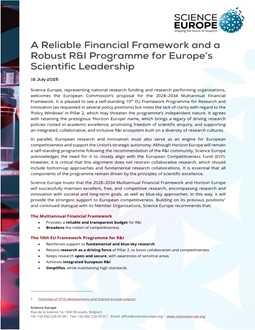
Science Europe's initial response to the European Commission's proposals for the next EU budget and new Horizon Europe, including a set of recommendations. While the proposals provide a significant budget increase and the Framework Programme remains self-standing, further clarification on its relation to the Competitiveness Fund is needed.
Science Europe made excellent progress on its research policy priorities in 2024, delivering key outputs in various areas, including science communication, research assessment, open science, the sustainability of research, international collaboration, and equality, diversity, and inclusion.
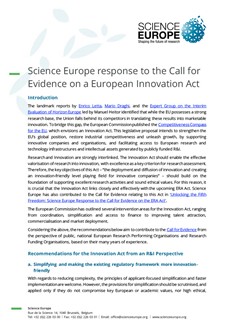
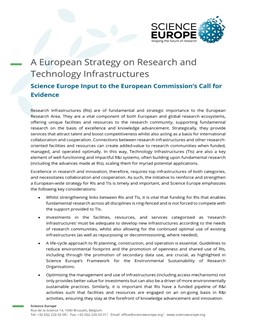
In May, Science Europe responded to a Call for Evidence by the European Commission on a European Strategy on Research and Technology Infrastructures. The response outlines a number of considerations to be taken towards these infrastructures, which are of fundamental and strategic importance to the ERA.
The second workshop on FP10 addressed the position of the upcoming Framework Programme for R&I in the Multiannual Financial Framework and its relation to the proposed Competitiveness Fund. The summary highlights concerns about prioritising short-term economic gain over fundamental research and SSHA disciplines.
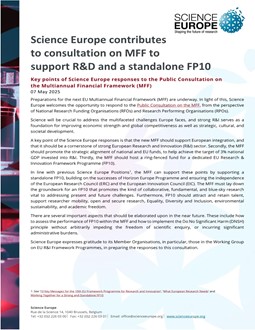
Science Europe has responded to the European Commission’s public consultation on the next Multiannual Financial Framework. It focuses on establishing a strong and ambitious MFF that strategically aligns national and EU research funding, and includes a ringfenced budget for FP10.
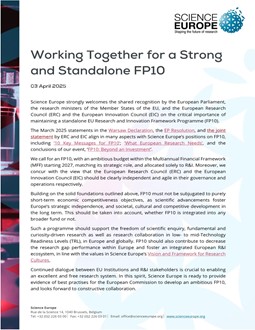
Science Europe proudly presents its statement, 'Working Together for a Strong and Standalone FP10', reaffirming the vital role of a dedicated EU Research and Innovation Framework Programme. Building on shared commitments from the European Parliament, EU research ministers, and the ERC and EIC, we advocate for an ambitious FP10 within the 2027 Multiannual Financial Framework. This programme must prioritise scientific freedom, curiosity-driven research, and a robust, independent R&I ecosystem to secure Europe’s long-term strategic, societal, and competitive future.
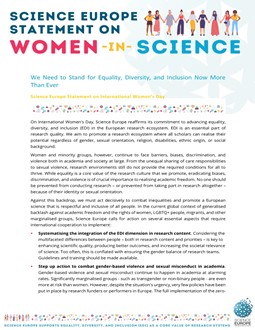
On International Women's Day, Science Europe reaffirms its commitment to advancing equality, diversity, and inclusion (EDI) in the European research ecosystem as an essential part of research quality. We aim to promote a research ecosystem where all scholars can realise their potential regardless of gender, sexual orientation, religion, disabilities, ethnic origin, or social background.
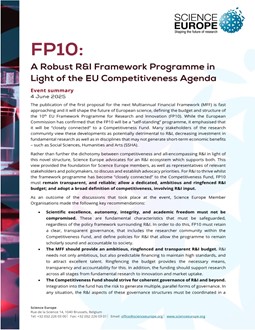
Leaders and senior-level representatives of Science Europe Member Organisations met in Brussels on 18 and 19 February to discuss Science Europe’s priorities for the upcoming 10th EU Framework Programme for Research and Innovation (FP10). The recommendations in the landmark reports by Enrico Letta, Mario Draghi, and the Expert Group on the Interim Evaluation of Horizon Europe led by Manuel Heitor were taken into account. The event was kindly hosted by the Research Foundation Flanders (FWO) in Brussels, with the Commissioner for Startups, Research and Innovation Ekaterina Zaharieva participating in the opening session.
This statement presents the conclusions of these discussions.