Skip to content
Large stack of files with multicoloured paperclips attached on a wooden desk, stack aligned to the left of the picture
Large stack of files with multicoloured paperclips attached on a wooden desk, stack aligned to the left of the picture © eaglesky

Research Assessment Reform

The processes and practices that structure research assessments are key to ensuring and enabling the quality of research. There is a need to diversify the activities, outputs, and outcomes that are recognised as part of research assessment processes. Equally, a broader set of skills and competencies must be acknowledged and valued as part of the assessments of researchers, both for funding allocation and career progression.

Science Europe works to ensure that research quality remains the core principle that underpins research assessment systems at all levels.

Why does research assessment matter?

Research assessment lies at the core of all Science Europe Member Organisations’ activities and is fundamental to the research endeavour. It is used to select projects and researchers for funding, for determining career progression, and to evaluate research units and institutes. It forms the basis for our recognition, rewards, and incentives systems and influences the behaviours and attitudes of the research community. As such, it shapes the way research is conceived, conducted, and communicated, and drives research cultures.

Science Europe’s Member Organisations dedicate significant effort and resources to ensuring that their assessment processes are fair, efficient, transparent, and effective.

What are the current priorities?

It is Science Europe’s priority to promote research quality as the most important factor in research assessment.

Research assessment must reward all research contributions and activities, and promote good research practices, reproducibility, and integrity. To that end, it needs to capture the diversity of research outputs and outcomes in a manner that is appropriate to each research field.

Ensuring that research assessment processes are transparent, effective, and fair is of fundamental significance.

What is Science Europe doing to achieve these aims?

Research assessment is a long-standing priority area for Science Europe. In recent years, Science Europe has taken a leadership role in driving discussions towards global and collective research assessment reform.

Current activities

Science Europe’s current activities on reforming research assessment aim to support the continued shift from principle to practice. Science Europe has recently contributed to three key resources that provide both practical and strategic guidance on implementing practices and policies that drive the reform of research assessment systems forward.
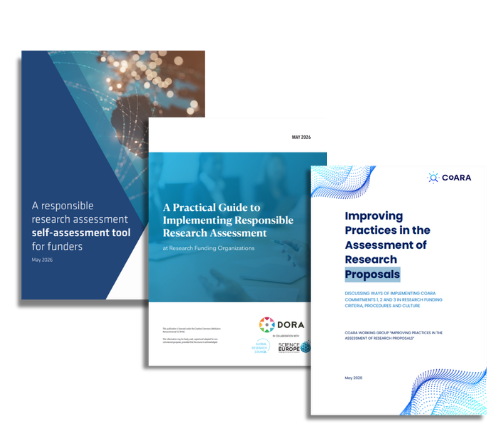
         Link                               Link                            Link

Science Europe continues to support all its Member Organisations and partners in their activities to continually adapt and improve assessment practices in support of research excellence, knowledge advancement, and broad impact.

  1. 2019
  2. Science Europe conducts a comprehensive study of research assessment practices with its Member Organisations and external stakeholders, identifying key opportunities and challenges facing assessment systems.
  3. 2020
  4. Based on the results of this study, and in consultation with experts, stakeholders, and the research community, Science Europe publishes a set of policy recommendations that represents a best-practice model for research assessment processes. At the same time, Science Europe recognises the strain that assessment systems are under and advocates a broader reform of assessment systems from a multi-stakeholder perspective.
  5. 2021
  6. With the European Commission’s Directorate-General for Research and Innovation (DG RTD) and the European University Association (EUA), Science Europe establishes a Drafting Team for an ‘Agreement on Reforming Research Assessment’. Science Europe also chairs a ‘Core Group’ of stakeholders that helps shape this Agreement.
  7. Science Europe’s activities on Research Assessment so far identified the need to develop a holistic perspective of the policies and practices implemented by research organisations that influence and intersect with the values, norms, behaviour, and activities of researchers and research communities. Science Europe establishes a new strategic priority on Research Culture, and a new strand of activities that aim to develop a values-based approach to R&I policy advances, governance, and management.
  8. 2022
  9. The Agreement on Reforming Research Assessment is published, and the Coalition for Advancing Research Assessment (CoARA) is launched. Many Science Europe Member Organisations are amongst the early signatories of the agreement and coalition members. The Science Europe Office co-leads CoARA’s initial secretariat.
  10. 2023
  11. As CoARA grows rapidly, Science Europe sits on its initial Steering Board, and joins the CoARA Boost Consortium to support the continued growth and expansion of the initiative.
  12. As part of the 2023 Global Research Council (GRC) Annual Meeting in The Hague, and in partnership with GRC Responsible Research Assessment Working Group, Science Europe hosts a side-event on research assessment reform.
  13. As part of the strategic focus on research cultures and values-based policy and practice shifts, Science Europe publishes a series of recommendations on recognition systems, entitled ‘Recognising What We Value’ 
  14. 2024
  15. With its Portuguese member, the Foundation for Science and Technology, and INESC-TEC, Science Europe co-organises the first CoARA National Chapters Forum in Porto.
  16. Science Europe conducts and publishes a survey offering a descriptive analysis of the role that public research funding and performing organisations in Europe play in the shifting landscape of open science and research assessment reform.
  17. 2025
  18. Research Assessment Reform is situated at heart of a new Vision and Framework for Research Cultures. It establishes a set of shared goals to contribute to longer-term strategic discussions on the direction of research systems in Europe and beyond, from a values-based perspective.
  19. Science Europe co-organises the EU high-level conference on reforming research assessment under the Danish Presidency of the Council of the EU, bringing together 300 participants from across the globe to discuss the status of the reform movement.
  20. 2026
  21. Four years since the launch of CoARA, 90% of Science Europe’s Member Organisations are members of the coalition, with many contributing directly to CoARA’s National Chapters and Working Groups.
  22. At the 2026 GRC Annual Meeting in Bangkok, Science Europe revisits the global reach of the research assessment reform movement, co-organising a side event exploring synergies between international initiatives such as CoARA, DORA, and FOLEC-CLACSO.


Member-only content is available on this page. Please log in to view this content.

Related content